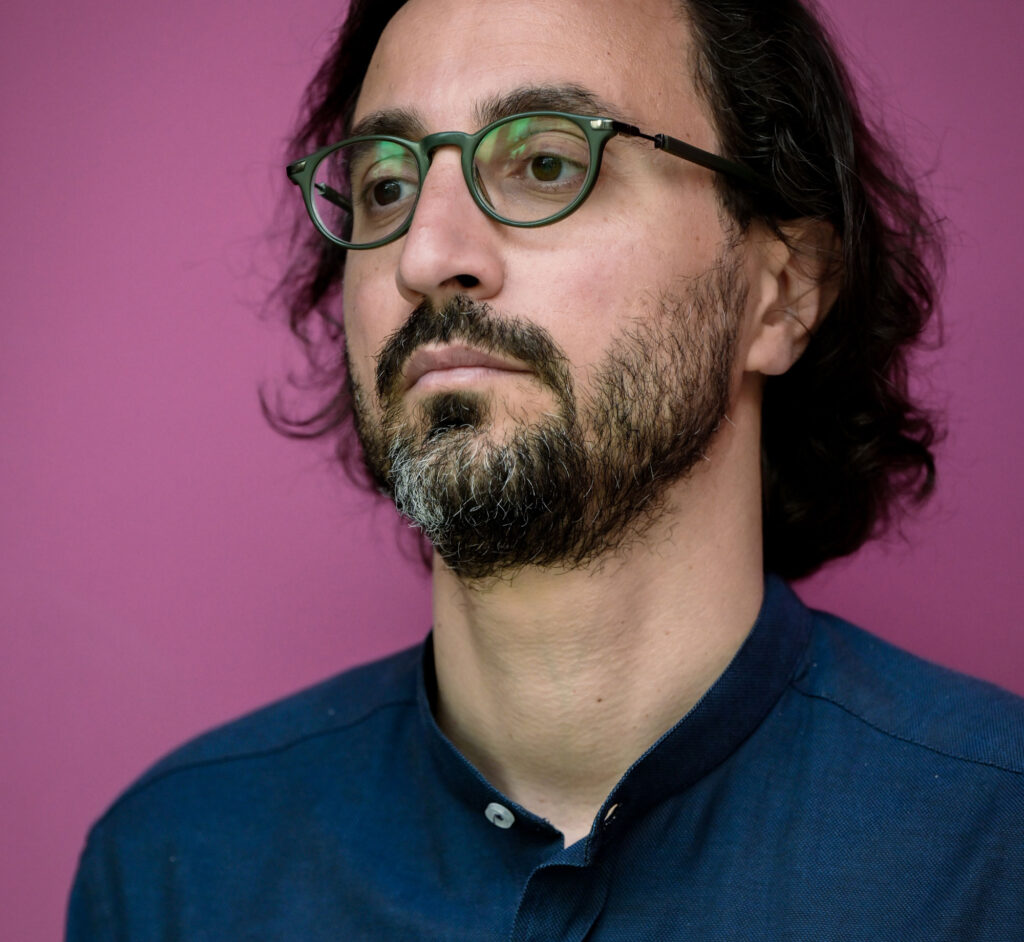
Biography
Lebanese composer, performer and artistic director, Wael Kodeih defies easy categorization. For over two decades, he has been transforming the sonic landscape of the Middle East, creating work that bridges historical divides and reimagines cultural artifacts for contemporary audiences.
Kodeih first emerged as “Rayess Bek” in the early 2000s, when Arabic hip-hop was virtually non-existent. As one of the first artists to rap in Arabic, he and his group Aks’ser helped establish a new musical vernacular for a generation finding its voice amid political turmoil.
His artistic evolution took a significant turn with “Good Bye Schlondorff” (2013), a multimedia performance that caught the attention of major institutions like Centre Pompidou, HKW Berlin, and Superdeluxe Tokyo, signaling his shift toward more experimental territory.
In 2015, Kodeih’s fascination with Arab cultural memory materialized in Love and Revenge, a project that samples and remixes footage from the golden age of Arab cinema. By reinterpreting these vintage visuals and sounds, Kodeih creates a dialogue between past and present that has resonated with audiences across 24 countries, earning showcases at the Philharmonie de Paris, Fondation Cartier, and Louvre Abu Dhabi.
Love and Revenge’s second incarnation, “Galbi Galbi,” dives into the archives of Lebanon’s legendary Studio Baalbek, excavating forgotten treasures and breathing new life into them through Kodeih’s distinctive electronic lens.
His reputation for thoughtful cultural excavation led the Philharmonie de Paris to commission “Agmal Layali” (2025), an ambitious tribute to Egyptian icon Oum Kalthoum that reimagines her timeless compositions through contemporary electronic arrangements and immersive visuals.
Other notable projects include “Strange Land” (2019), which weaves archival sounds with photography; “DABAKA” (2018), an electronic reinterpretation of traditional Levantine dabkeh dance music; and “4375” (2017), a nuanced exploration of the relationship between music and Islamic traditions.
Beyond his personal projects, Kodeih lends his compositional talents to film, documentary, and theater productions, further extending the reach of his distinctive sonic palette.
Through his multifaceted work, Kodeih doesn’t just preserve Arab cultural heritage—he transforms it, creating new contexts for appreciation while challenging audiences to reconsider their relationship with tradition and modernity.